
First time Mum: Kretheka's Birth Story

Kretheka was our prenatal yoga program student, and she and her husband attended the Yoga for Birth Couples Workshop together.
Their daughter, first baby was born on the 6th of June, without any medical interventions, in a birth that turned out to be far faster than anyone expected.
She has written it all down honestly, including the moments where her calm slipped, and the parts of postnatal life a month on that nobody warns you about.
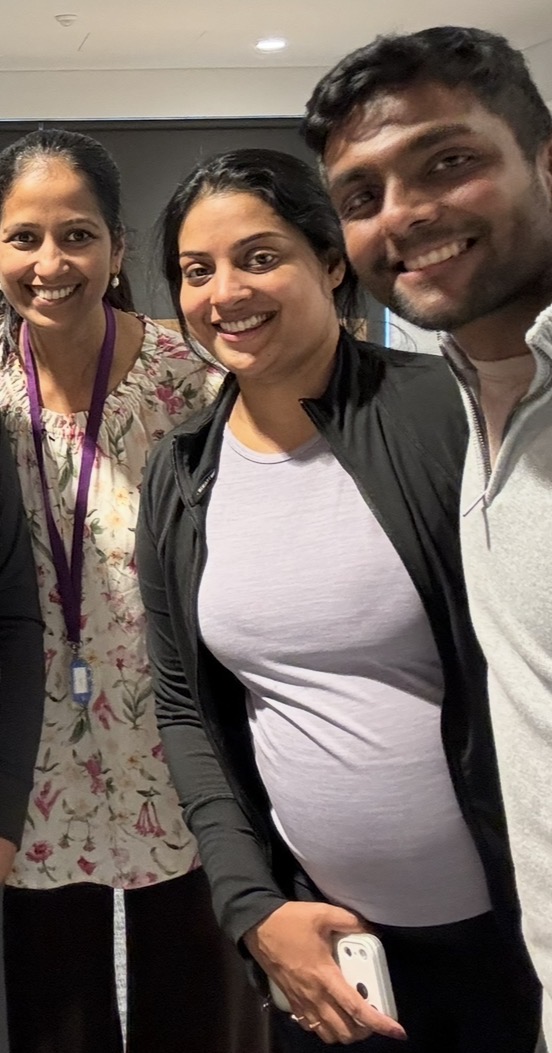
This is her story, in her own words. Her story shows how much your care provider matters, how much partner/support preparation matters, and what a positive birth actually feels like from the inside. Thank you Kretheka for sharing your story.
An ordinary Friday

Friday the 5th of June was meant to be an ordinary day. My due date was the 16th, and my doctor had said to expect her any time from the 9th, so I still felt like I had time. My next appointment was not until Monday.
I had been into the office in the city on Thursday and out at an event that evening, and I worked from home on the Friday. That night we went shopping and ended up going back and forth three times because we kept forgetting something. On the last trip I felt more tired than usual. We picked up a fig and date shake on the way home. Back home I did my colostrum expression, which had been my routine since the 35th week of my pregnancy.
A small leak
Then I went for a shower and felt a small leak. I assumed I had simply wet myself and finished washing. But when I stepped out onto the bathroom floor there was a little more water, and this time it seemed unusual. I remember thinking, maybe this is my waters breaking.
I had been taught to record TACO: time, amount, colour and odour. The colour looked slightly off to us, not quite clear, though it was hard to tell against a dark bathroom floor. My care provider on call told me to put on a pad and ring back in an hour.
I had already decided I would stay calm through all of this, in Zen mode, and I had asked my family to do the same. About half an hour after my waters broke, mild period cramps started, and that was the moment things began to feel real.
The moment my calm slipped
When the hour was up, the pad was slightly yellow with a faint odour. I rang the midwife on call. She thought the baby may have passed meconium and asked me to come in. It is common late in pregnancy, she said, though it can also mean the baby is distressed.
I will be honest about this part. I looked up meconium online while we were getting ready, and reading about what it could mean and how much time we had sent me into a bit of a panic. My advice to anyone else would be not to read anything at that point. My calm slipped, and I asked my husband if we could leave straight away. He asked what had happened to my Zen. I did not tell him then, because I did not want him panicking too.
The drive in
We loaded everything into the car and went. On the way we took our car selfie, talked to our little girl, prayed to my mum, and put on our calming songs and the playlist we had curated for her and played to her through the whole pregnancy. All of it brought me back to my Zen.
Timeline, part one
11:15 pm - waters broke
11:45 pm - period-like cramps started, and I noticed what seemed like my mucus plug on the pad
12:15 am - check-in call with the midwife
1:00 am - arrived at hospital
As soon as we reached the hospital, the midwife asked me to change my pad and leave it in the bathroom for them to check. She had also been in touch with my doctor.
What I had asked for: Birth Preferences
Some background here. I had completed my birth preferences and talked them through with my doctor beforehand. I did not want any artificial intervention unless it was needed for my baby's safety. I wanted to try the natural way as far as I could. When I filled in the form I deliberately did not tick epidural or morphine, even as an option if required, because I wanted to prepare my mind to get through it without pain relief. I wanted an active, mobile labour so I could manage with movement. I felt that my own confidence and my husband's support would carry me through.
I had been told that gas works well for some people and not for others, so I was considering a TENS machine and was due to pick one up on Monday. My little one arrived before then, so fortunately or unfortunately, it never made it in time. Instead we relied on my husband, my breathing and everything else we had learned.
Wait and watch
The midwife asked my doctor whether I would need to be induced, since the baby had passed meconium. My doctor was very clear that we would wait and watch until the morning, in line with what I wanted. Her reasoning was that induction would make labour progress quickly, which would have made it much harder for me to manage naturally. Instead they monitored the baby's heartbeat and mine continuously.
Settling in

We settled in at Jessie McPherson Private Hospital in Clayton, and my labour progressed through the night. From the moment we arrived I felt incredibly supported. My obstetrician, Dr Annie Kroushev, and the midwives were wonderful. The birth room was already set up with fairy lights and a birth ball, which I had not expected at all, and it felt so calm that we hardly needed anything we had packed ourselves.
The midwife in the room went over my birth preferences with me again and let me know the gas was there if I wanted it. Everything looked reassuring, and my care team encouraged me to keep labouring naturally, which was exactly what I had hoped for. I felt respected and supported in every choice I made.
One question that changed my labour
To begin with, I was connected to a monitor by wires and had to stay sitting on the bed. As my contractions started building, I found I could not manage lying or sitting still, so I asked the midwife whether there was another way to monitor us that would let me move around. She suggested a Bluetooth device, warning me that it does not connect well for everyone but was worth a try. We switched over, it was attached to my belly, and from then on I was free to move. I had it connected to me even when I was in the shower. If you are hoping for an active, mobile labour, it is worth asking your care team whether it is available.
How I moved through it
Throughout labour I kept changing positions and using whatever comfort measures felt right in the moment. My husband gave counter pressure on my hips during contractions, I spent a lot of time on the birth ball, and I found the warm shower incredibly soothing on my back. The breathing technique that carried me through was horse lips, which I had learnt in prenatal yoga and the Yoga for Birth program. My husband did it alongside me the whole time.
At one point he said, only half joking, that everyone tells you what to do during a contraction, but nobody tells you how many contractions there will be.
I never could stay on the bed. If I lay down and a contraction came, I had to get straight back up, onto my knees or my feet, leaning forward with my hands resting on the bed.
Holding on to 8 am
By around 3:00 am my midwife let me know that my OB would be in at 8:00 am, and that we could reassess and talk through the options then if labour had not progressed. I was already in a lot of pain, so I was shocked when she told me I was not yet in active labour, and that a first labour can take twelve to eighteen hours and varies from person to person. I fixed on 8:00 am as my target and decided I would manage the pain until then. By this point we were both tired, and we both wished there was some way of knowing how much longer we had to go, which there is not. I went and stood in shower for about 3 times in the course of labour to help me manage pain.
When things intensified
A little while later, around 5:00 am, I noticed blood on my pad and my contractions became much more intense. Every time I changed a pad or used the bathroom there seemed to be more of it. The midwife said at first that some bleeding is common, but within the hour it was heavier than expected. At one point I was in the shower, and in the water it looked like more. By then I was in enough pain that my husband asked whether I should take something for it. I did not answer him. He went straight back to encouraging me and telling me I could do it. That was what kept me going, and I held on to my mother, looking at her photo for confidence.
Around this time I also started vomiting. I had been drinking peach electrolytes steadily since we arrived, so it tasted like peach rather than anything sour or burning, which made it far more bearable. My last meal had been at about 7:30 pm, unusually early for me.
Around 6:00 am my midwife suggested I try the gas. I am not sure it did much for the pain, but it helped my breathing enormously. More than anything, it slowed me down and kept me focused through each contraction.
She was already here
An hour or so later I felt like I needed the bathroom. The midwife told me to be careful and to keep the door open, because there was a chance the baby might come. I honestly thought she was joking.
My obstetrician arrived while I was in the shower, having been called because my bleeding had increased. I was standing when she arrived, but she could not check me properly standing up, so I moved onto the bed.
To everyone's surprise, including mine, I was already fully dilated and my baby's head was crowning.
My doctor asked me to give a small push so she could check, then told me we were nearly there. She said she would tell me exactly when to push, and that until then I only had to breathe calmly.
8:27 am
With just a few pushes, guided entirely by my OB, our daughter was born at 8:27 am on the 6th of June. I could not believe it. We had spent the night waiting on an 8:00 am reassessment, and by 8:00 am she was almost here.
My midwife was about to give me oxytocin to help deliver the placenta, but my doctor asked me for one more push first, and it came away on its own before the injection was needed.
Timeline, part two
3:00 am - contractions progressing, but not yet active labour. Told my OB would come at 8:00 am
5:00 am - bleeding, and much stronger contractions
6:00 am - started using the gas
Around 7:30 - 8:00 am - examined and found fully dilated, baby crowning
8:27 am - our little girl was born
The first hour post birth

I was so grateful to have no perineal tears, only minor grazes and one superficial wound that needed a single stitch to help it heal faster. It was all healed within a week. My doctor joked that I looked like I had never given birth at all.
I was up and moving soon afterwards. I had my daughter on my chest for over an hour and fed her, then handed her to my husband, had a long shower, and walked around the room before we were moved to the ward. The first hour of her on my chest, trying to find my breast to feed, was really marvellous.
What made it a positive birth
Looking back, I feel so thankful for the care I received from Dr Annie Kroushev and the midwives. I felt listened to throughout my labour, my birth preferences were respected, and I was always involved in the decisions being made. That continuity of care made all the difference.
I stayed in hospital for five days and felt strong, capable and completely empowered the whole time.
I learnt afterwards that what I had experienced was a precipitate labour (an extremely fast birth where the baby is bran wiping three hours of regular contractions starting) and a primary postpartum haemorrhage (more than 500 ml of blood loss after giving birth), both of which were managed so well that I barely felt the weight of either at the time.
This birth reminded me that a positive birth is not about everything going perfectly. It is about feeling calm, confident, supported, informed and respected. For me, that is exactly what it was.
Top three things I would recommend
- Ask for what you need. The single biggest change in my labour came from asking whether there was another way to be monitored. One question, and I went from stuck on a bed to free to move for the rest of the night. Your care team cannot offer what they do not know you want.
- Do not look anything up once labour has started. When I heard the baby had passed meconium I read about it online, and it took me from calm to panicking within minutes. Everything I actually needed to know, my midwife and my doctor told me. Leave your phone for the music and the photos.
- Prepare your partner, not just yourself. My husband gave counter pressure through every contraction, did the breathing alongside me, and knew when to say nothing at all. None of that was instinct. It came from the classes (Yoga for birth) we did together.
Other things that helped
- Staying off the bed, and moving whenever I needed to.
- The warm shower on my back.
- Setting myself a target time and refusing to think past it.
- Our playlist, the one we had played to her all through the pregnancy.
- My mother's photo.
- And my husband, there through every single contraction.
What helped most from the prenatal and Yoga for Birth programs
Horse lips breathing, more than anything else. It was the only technique I could still do properly once the pain was real. I had practised the others well, but under contractions I simply could not hold them. My husband doing horse lips with me made it easier again.
The other thing that stayed with me was the confidence to keep moving and keep changing positions, rather than staying where I was put.
Counter pressure on my back and hips helped too, though not consistently. When you need it that many times over that many hours, the pressure naturally starts to drop, and it stopped doing as much for me. That is not a criticism of my husband. It is just the reality of asking one person to do something physical for hours on end.
How's postnatal recovery feeling one month after?
Ups and downs, honestly!
The first two weeks I felt confident and fully prepared. Then came the days where I had no idea what I was doing, when she cried and I could not work out why. I was breastfeeding exclusively and had to fix a few positions and techniques along the way. The council lactation consultant was so helpful and supportive with all of that, and I would tell anyone not to wait before asking for that kind of help in addition to your family support.
The tiredness and the broken sleep have caught up with me now. Physically I healed quickly, but a month of nights is its own thing. I am trying to get myself out of the house as much as I can, even just for a short walk, because moving still makes me feel more like myself. Small walks with the little one make it more enjoyable.
My husband and I are working it out as we go, the same way we did through the night she was born.
And then there are her small smiles, arriving out of nowhere in the middle of a tired day. They make all of it worth it.
Word from Ragini (Mother'z Yoga)
What shines most in Kretheka's story is that she took charge of her birth from the very beginning. She prepared herself, and she made sure her husband was prepared too as she already knew he would play a key role.
And he did. The moment that stands out to me is: he asked if she wanted something for the pain, she did not answer, and he read that silence correctly and went straight back to encouraging her. Knowing when to offer and when to step back is hard to get right. That is not instinct, that is preparation.
Next is the role of her care provider and how she respected Kretheka's Birth preferences on the day in every manner possible.
Birth will always have a surprise factor. Hers came early and fast than expected. Which is exactly why your pillars matter: a care provider who listens, being prepared yourself, and a support person genuinely ready to be there with you. Get those three in place, and whichever way your birth goes, you are far more likely to come out feeling positive about the whole experience.
Learn more about our Prenatal Yoga Program and Yoga For Birth Couples Workshop.
Ready to Experience the Benefits of Prenatal Yoga?
Don't wait—start your journey with Mother'z Yoga today! Sign up now for a 7-day free trial and discover how our online prenatal yoga program can help you stay strong, calm, and connected throughout your pregnancy.
